Internal / external step composed of tread and riser in 20 mm thick plywood. The tread is covered with black grooved rubber; the risers and side panels are finished in black laminated board.
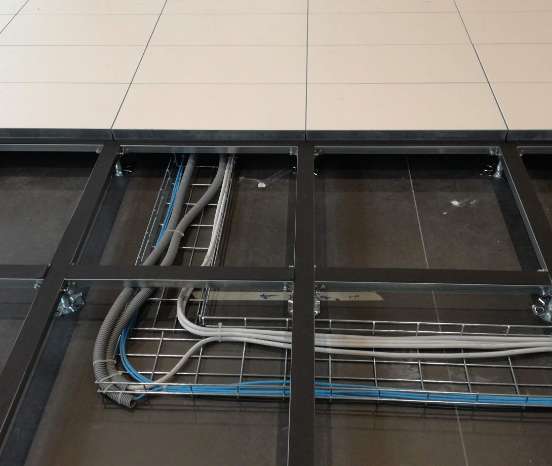
The raised floor, also known as a floating floor or access floor, is a system that elevates the walking surface above the structural slab to create a plenum underneath. This space accommodates various types of technical installations, such as electrical, plumbing, data, and air distribution systems.
The system is composed of modular, interchangeable panels supported by a steel structure, allowing easy access at any time to the underfloor installations for maintenance purposes. Installation is completely dry and enables a flexible spatial layout.
An ideal solution for both renovations and new constructions
Office
Datacenter
Museum spaces
Retail
School
Sanitary
Residential
Indoor
Outdoor
Raised floor panels are the result of assembling different materials.
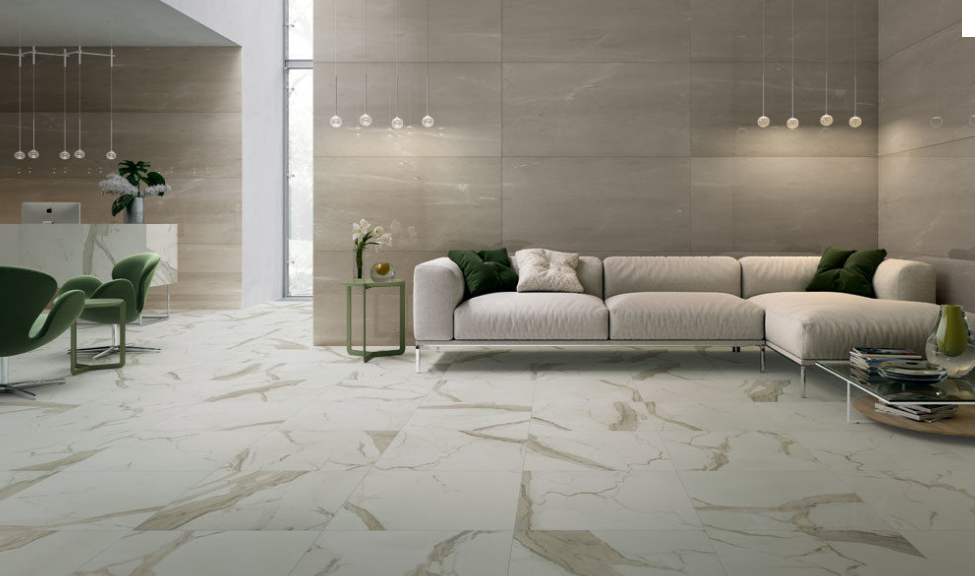
Raised floor panels are made by assembling different materials. The top surface of the panel consists of the chosen finish, bonded to the substrate, such as porcelain stoneware, parquet, laminate, vinyl, and the full range of materials offered in the flooring section.
The underside, that is, the face facing the subfloor, can be covered with an aluminum sheet, a steel tray, or left unfinished in the case of calcium sulfate panels. Along the perimeter, a plastic edge is bonded, available in different colors and thicknesses, serving as an expansion joint
The central part of the panel, called the core or substrate, provides the main mechanical performance of the raised floor and can be made from different types of materials:
Wood composite: (also known as particleboard), made from recycled wood and mainly used in 38 mm thicknesses, with densities of 680 or 720 kg/m³;
Calcium sulphate: composed of gypsum and cellulose fibers, available in various thicknesses and densities, such as 1,100 or 1,500 kg/m³;
X-FLOOR: an inert mixture sintered at very high temperatures, made entirely of ceramic with a monolithic and homogeneous structure, having an average density of 2,200 kg/m³.
This property depends on the size and substructure of the molecular particles. The wood particles that make up the wood composite absorb much more moisture and water compared to calcium sulfate. The X-FLOOR, on the other hand, is completely non-absorbent.
Noise reduction capacity refers to the ability to interrupt the frequency of sounds transmitted through materials.
Note: The noise reduction capacity is strongly influenced by the type of horizontal structure (slab) on which the raised floor will be installed.
Calcium sulphate has good noise reduction capacity due to its compact and homogeneous structure. The wood composite, despite having roughly half the density of calcium sulphate, provides slightly better noise reduction thanks to its physical composition. Finally, X-FLOOR falls in an intermediate position between the two.
It should be noted that the potential for resonance effects in a raised floor is closely related to the morphology and structural characteristics of the building itself. Very large rooms, absence of subfloor partitions, and the presence of ventilation grilles are all conditions that can create an unpleasant subfloor resonance effect, turning it into a “resonance chamber” for noise generated by foot traffic and other sources.
Thanks to their ability to resist bending even under significant loads, panels with a calcium sulfate core and X-FLOOR provide excellent walking comfort, giving the sensation of walking on a surface closely adhering to the ground. In contrast, under the same load, wood composite panels exhibit greater flexibility and elasticity.
Reaction to fire refers to the degree to which a combustible material contributes to a fire when exposed to it. Fire resistance is the ability of a building element (component or structure) to maintain, for a specified period, the required stability, integrity, and/or thermal insulation. Calcium sulphate is composed of mineral materials that are heat-inert, meaning they do not contribute to combustion; the same applies to X-FLOOR, which is made from an atomized mixture of clays, kaolins, and feldspars. The particleboard core, however, being made of wood composite and resin-based binders, does contribute to combustion.
Sealed raised floors have been designed for situations where liquid infiltration into the plenum is likely and it is necessary to keep it dry (bathrooms, laboratories, healthcare facilities, kitchens, etc.). If access to the plenum is required, the seal can be removed and reapplied afterwards.
Conductive raised floors are required in environments where delicate electronic equipment is in operation and electrostatic shocks must be avoided (laboratories, computer rooms, cleanrooms, etc.).
The panel can have a core of variable thickness made of calcium sulphate or wood composite, with a lower layer of aluminum sheet, steel tray, or galvanized steel plate, and an upper finish chosen from PVC, rubber, or linoleum. It is essential that the upper finish possesses conductive properties, as well as the adhesive used for the upper finish and the lower layer.
Additionally, it is recommended to provide electrical bridges on at least two sides of the panel (preferably opposite sides). These are cuts from the top edge to the bottom edge of the core, approximately 25 mm deep and 3 mm thick, into which a conductive graphite-based compound is poured. This ensures electrical connection between the upper and lower finishes.
Finally, the structure must be metallic, with conductive gaskets on the columns and crossbars to allow the dissipation of electrostatic charges.
The SNF substructure, featuring a head specifically designed for the company, is the most commonly used system for installing raised floors. It is made of galvanized steel and available in various heights, ranging from 35 to 1,025 mm. The pedestal consists of a head, tube, and base, and can be complemented with connecting stringers.
The stringers come in three types:
L: light, with a 15/18 mm flange;
M: medium, with a 30 mm open-section flange reinforced with stiffening ribs;
H: heavy-duty, with a 25 mm closed-section flange.
All components of the SNF structure are hot-dip galvanized using the Sendzimir process. The structure is completed with plastic gaskets that serve as anti-vibration and anti-impact elements, placed in contact with the panel.
The SDFE Extra substructure is used in applications subject to particularly heavy loads. It features pedestals with a specially designed head to accommodate galvanized tubular stringers with a closed rectangular section of 25×50 mm, positioned above the head and secured with threaded screws. The system allows for height adjustments ranging from 70 to 1,000 mm.
Soft-lay is the ideal solution to ensure the lowest acoustic impact of a raised floor system while maintaining its technical performance unchanged. It consists of an insulating rubber mat installed beneath the floor to reduce inter-floor noise transmission caused by foot traffic, placed between the structure’s base and the slab. Made exclusively from high-quality rubber compounds, it is capable of damping vibrations and offering exceptional compression resistance, thanks to the absence of air in the product’s physical composition.
Galvanized steel head, 80×80 mm, with 8 spokes designed to accommodate snap-on stringers made of high-strength, hot-dip galvanized square-section steel, 18.5×18.5×1.2 mm, available in different heights and equipped with a leveling nut positioned on the threaded rod. For lengths exceeding 298 mm, a Ø 20×2 mm tube is used. The base is made of galvanized steel, 80×80 mm, with four Ø 8.5 mm holes for possible mechanical floor fixing, and features ribs to adapt to uneven subfloors.
S-LOCK SYSTEM is an innovative raised floor system featuring a substructure equipped with a self-centering gasket made of self-extinguishing polymer, positioned in the four holes located at the corners of the panels. This system allows for quick and precise installation, eliminating the need for frequent adjustments and maintenance, while creating a monolithic effect that enhances safety and structural integrity.
PB is an adjustable polypropylene pedestal designed for the installation of all types of outdoor flooring: natural stone, porcelain stoneware, and composite materials. Thanks to its solid structure and enlarged head, it ensures perfect stability and even load distribution, even on uneven surfaces. It stands out for its ease of installation and its resistance to weather conditions, temperature fluctuations, and chemical agents.
Special Evolve adjustable pedestals are designed to provide robust, self-leveling support for raised outdoor flooring systems.
They feature an innovative self-leveling system that ensures greater stability during the installation of the flooring.
Easy and quick to adjust, either using the adjustment key or by rotating the base thanks to the new Locking Head system.
The material used to manufacture the Special Evolve adjustable pedestals is specially reinforced polypropylene, designed to ensure long-lasting durability and increased load-bearing resistance.
To fully appreciate the functionality and flexibility of the raised floor, a range of complementary accessories is available.
The use of these accessories, manufactured in compliance with international safety standards, makes the raised floor easy, practical, safe, and functional to use, fully meeting the flexibility requirements for which it is designed.
Used for lifting panels and accessing the underfloor cavity. Suitable for lifting panels weighing up to 15 kg.
Used for lifting panels and accessing the underfloor cavity. Suitable for lifting panels weighing up to 30 kg.
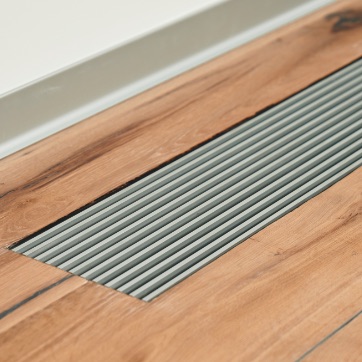
For air circulation (for underfloor air conditioning systems).
Internal / external step composed of tread and riser in 20 mm thick plywood. The tread is covered with black grooved rubber; the risers and side panels are finished in black laminated board.
Internal / external ramp composed of a 20 mm thick plywood inclined plane, covered with black grooved rubber. The sides are protected with PVC edging. Side panels are finished in black laminated board.
Panel cutting with resilient/hard top finish and aluminum/steel bottom finish for the installation of electrical floor boxes
.
Find the raised floor that best meets your needs